About Me
The facilitator other facilitators call when things get complicated.
For over two and a half decades, Nadia Chaney has been the person people turn to when standard approaches aren’t enough. She is proud and grateful to only work with groups she truly admires: senior NGOs, philanthropists and government officials changing the ways they collaborate for large scale shift, activist networks healing internal fractures, indigenous organizations working to realign cultures, corporate leaders bringing empathy and spirituality to their operations, and AI technologists grappling with the ethics of their innovations. What do they all have in common? They needed someone who can handle complexity without losing sight of humanity.For over two and a half decades, Nadia Chaney has been the person people turn to when standard approaches aren’t enough. She is proud and grateful to only work with groups she truly admires: senior NGOs, philanthropists and government officials changing the ways they collaborate for large scale shift, activist networks healing internal fractures, indigenous organizations working to realign cultures, corporate leaders bringing empathy and spirituality to their operations, and AI technologists grappling with the ethics of their innovations. What do they all have in common? They needed someone who can handle complexity without losing sight of humanity.
What makes Nadia different isn’t just her experience, it’s her unusual combination of capabilities. She’s simultaneously a systems strategist and a multimedia artist, a conflict mediator and a science fiction writer, a poet, and an experience designer.
This isn’t diversification for its own sake; it’s a stacking of lenses that offers rare insight, while also refracting their prisms. While others might see contradictions, Nadia sees the whole picture. Her artistic practice sharpens her ability to sense what’s emerging in groups. Her systems thinking gives structure to intuitive insights. Her decades of community work taught her that transformation requires both fierce clarity and deep compassion. And she constantly fails-but-attempts to root everything in a deep, ecological connection to lineage, body and place.
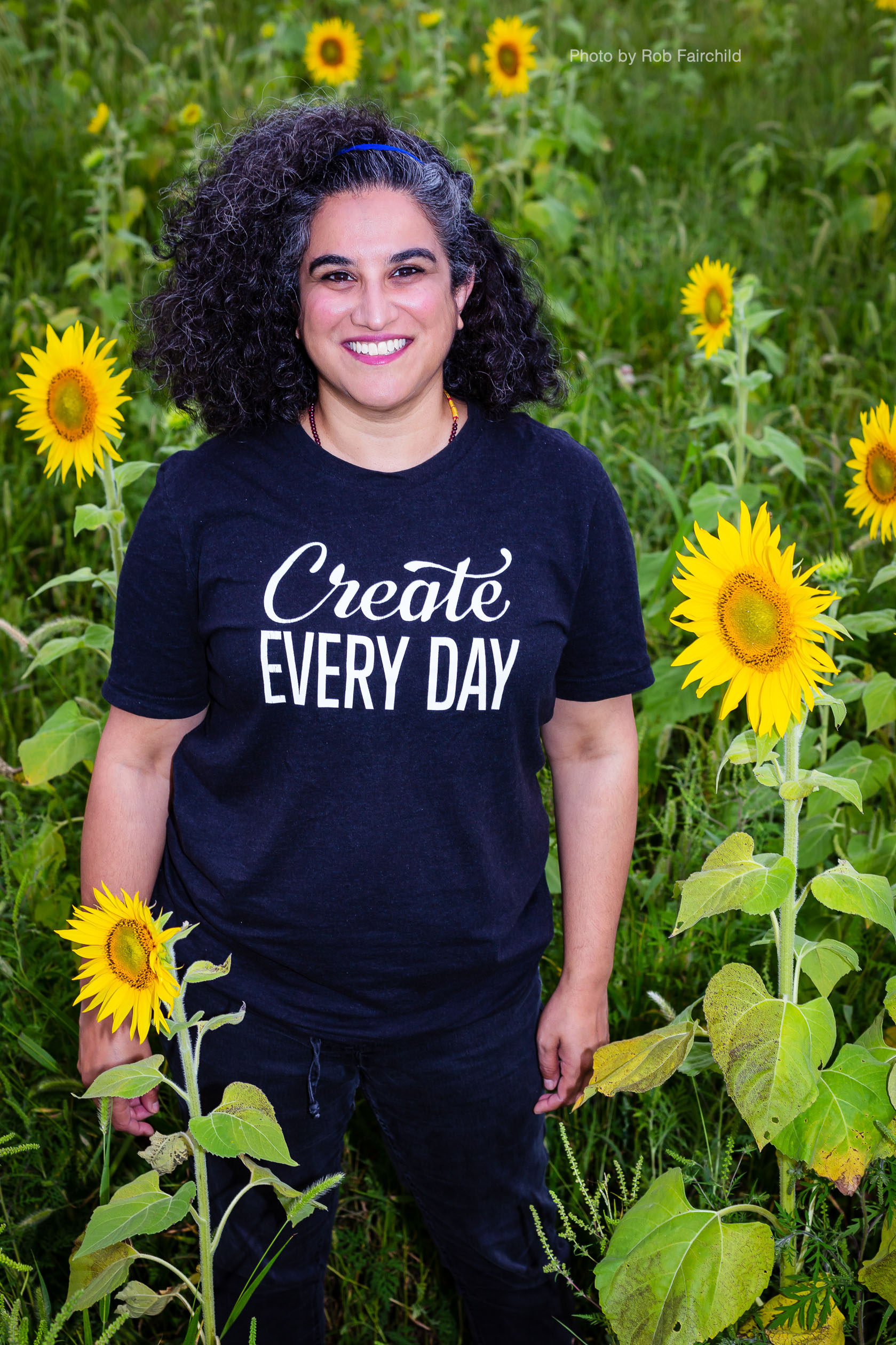
Facilitation that actually works when the stakes are high. Based in Ottawa, working globally, Nadia brings threshold practices to wherever complexity lives.
Training & Education
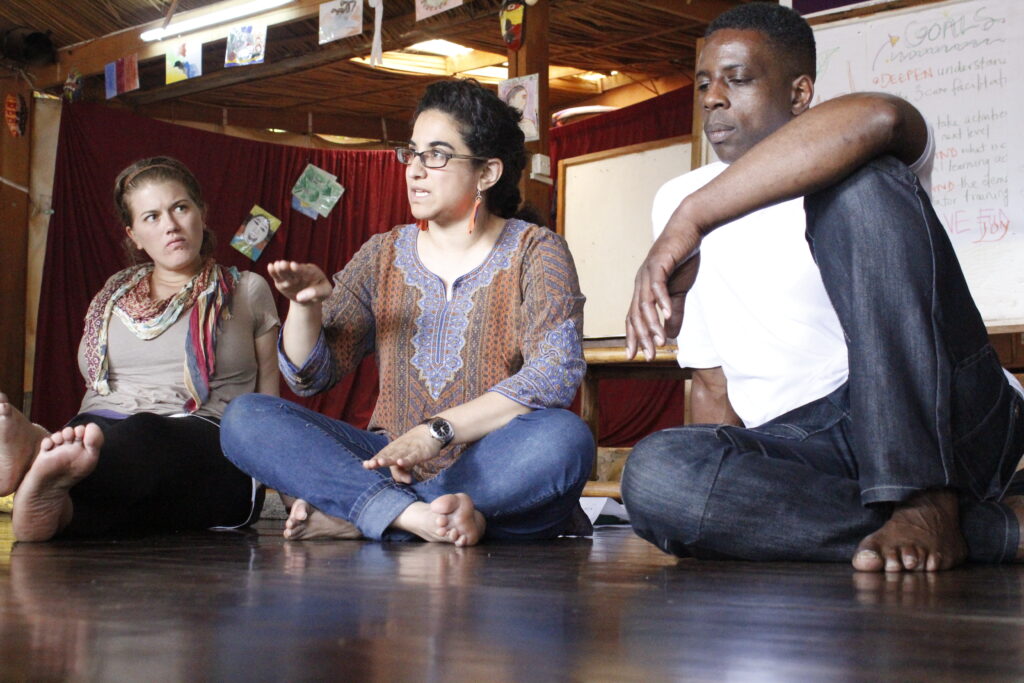
My formal education includes a Master’s degree with the Imaginative Education Research Group (CIRCE) from Simon Fraser University (2010), an advanced diploma in Expressive Art Therapy for Groups from the European Graduate School (2019), and a diploma in Dialogue and Negotiation from Simon Fraser University (2007). But, honestly, my real education has come from over 2,250 workshops facilitated across the globe since 2001, working in contexts ranging from youth detention centers to international organizations, from community conflicts to corporate transformations.
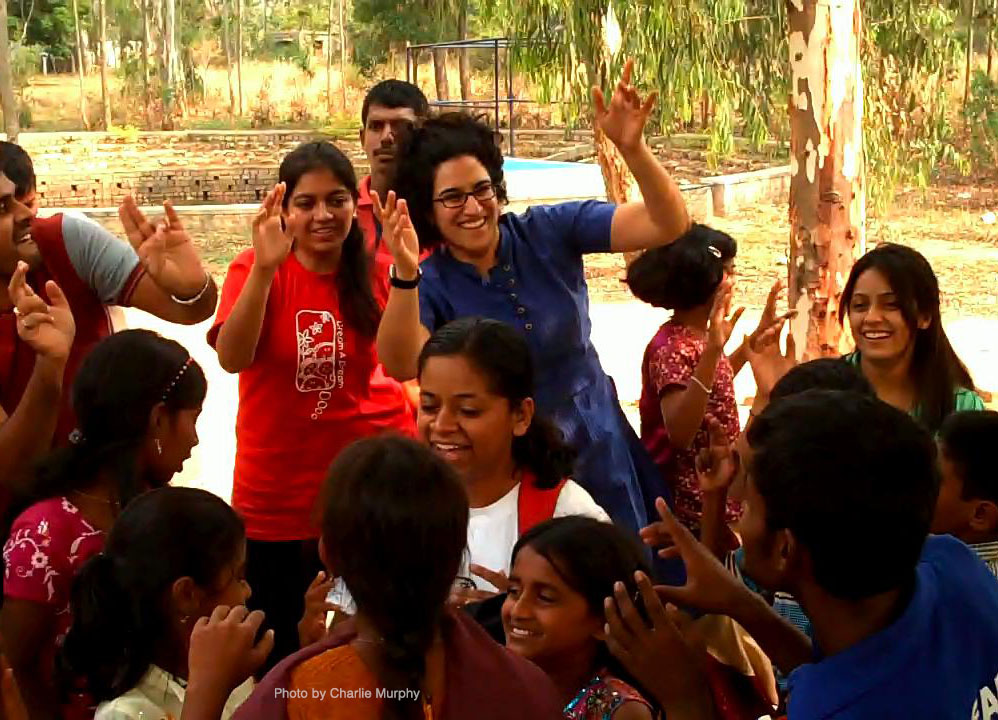
I was closely mentored for fifteen years with two incredibly innovative social artist-facilitators, Peggy Taylor and Charlie Murphy from PYE (Partners for Youth Empowerment). I’ve been mentored by world-class artists including Ruth Zaporah in Action Theatre, Chris Abani in creative writing, Hanif Fazal in group dynamics, Linda Rabin in continuum dance, Victor Porter in popular theatre, Geri deStephano-Webre in subtle energetics and John Turner in clown performance.
Some of my most powerful learning has been with co-facilitators who have walked with me for many years, these include but are not at all limited to: Sara Kendall (physician), Ruby Singh (musician), Vanessa Richards (social artist), Melodie Kauff (social artist), Suchetha Bhat (and everyone at Dream a Dream), Khari Wendall McClelland (social artist), Melanie Schambach (community muralist), Vishal Telreja (social artist), Andrew Kushnir (verbatim theatre), Emily Yee Clare (consentfulness), Michelle Peek (Art Not Shame), Ella Cooper (Black Women Film), Tammy Lea Meyer (psychospiritual facilitator), Sense Turner (social artist) and many, many others.
Why I Do What I Do
I do what I do because a good facilitator takes the shape of the time they’re in (by the element of space) and is stretched and learns about the world that way.
Twenty-six years ago, I started facilitating without even knowing the word “facilitation,” driven by a belief that people needed spaces to express themselves, to grapple with difficult truths and to transform together. What began as entertainment nights and community forums evolved into a lifelong obsession with messy, complex interactions and relationships.
People need people like me who can help groups move through conflict toward understanding, who can create conditions where lower or dissenting voices can be heard, confronting spaces where we self author and interrupt each other, or spaces where unconventional art forms reveal the gestures of possibility and connection that actually shift things.
I created Toolsi (online learning platform since 2022) and Knotty Groups (training in cooking with tension since 2023) because I believe every facilitator including myself needs access to a space to keep learning.
My Journey as an Artist & Facilitator
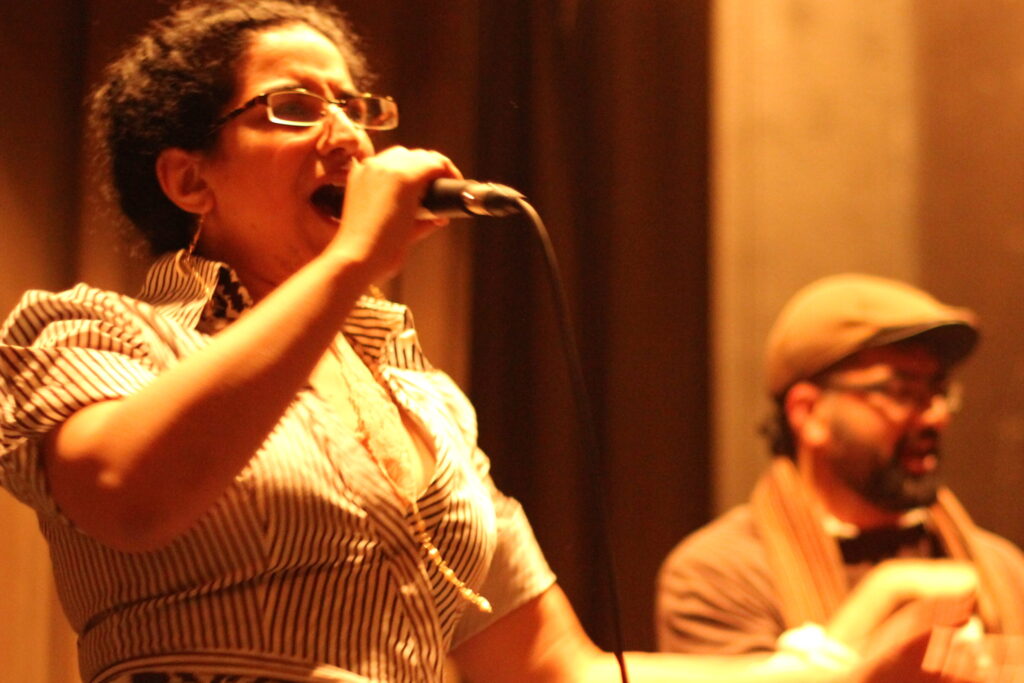
I’m an interdisciplinarian: poet, visual artist, musician, animator, writer, social practice artist (and whatever else comes barrelling into my life) because life is interdisciplinary and the most urgent questions we face can’t be contained in a single medium. I started on stages in my early twenties, performing spoken word poetry at open mics and community forums, opening for artists like Michael Franti and D’bi Young Anitafrika, eventually winning poetry slams (including the Words Matter Slam at the iconic Nuyorican cafe in NYC in 2013) and getting published in literary journals across North America (I even won best literary publication at Montreal’s notorious Expozine festival in 2018!).
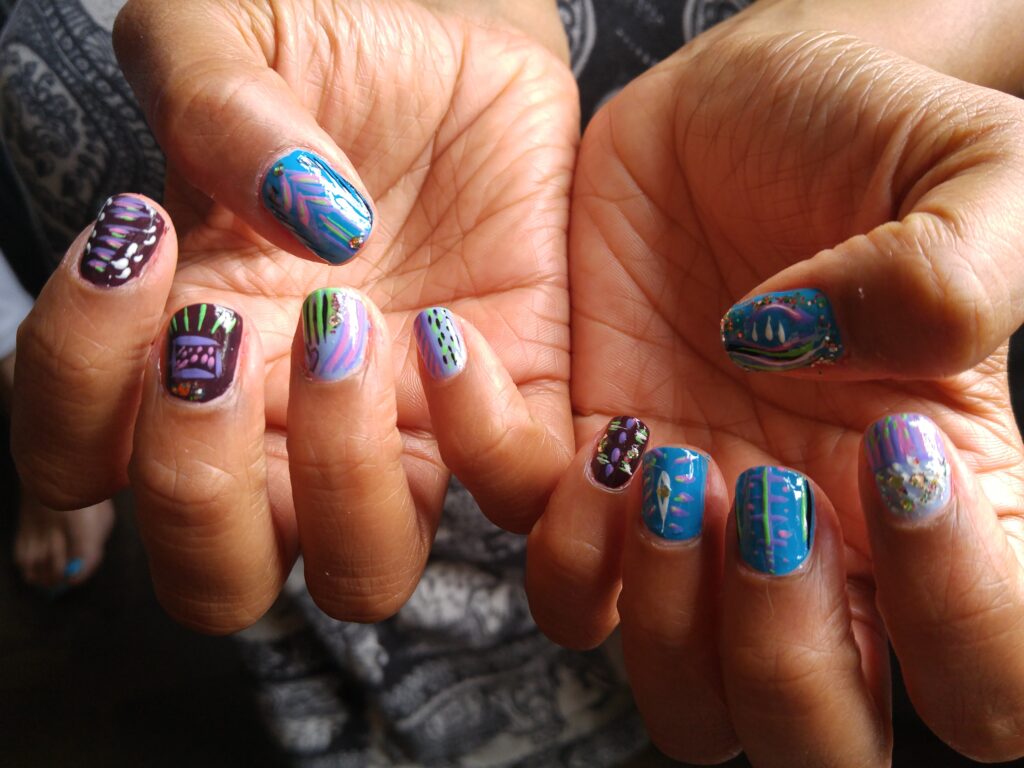
I created hip hop bhangra fusion music with Ruby Singh, Tarun Nayar and Raul Espinoza with BPM/Banyen Roots and hip hop music for young people as a founding member of the Metaphor Crew, touring across Canada and weaving lyrics that bridged my Indian-Canadian identity. We did over 300 shows! While some of my early work can be awkward to me now, I’m grateful to have had such a prolific and exciting experience of the arts in my twenties.In 2014 I started automatic drawing and painting, creating over 300 pieces in the first two years that eventually became the foundation for “Indivisible,” an interdisciplinary performance at the MAI in Montreal in 2018 that combined dance, animation, and improvised poetry. In 2010 I obsessively did manicures, on over a hundred people abstracts, tiny portraits and landscapes on fingernails.
Whether I’m hosting “The Psi Co Sly Sho” which happened in 2001 (a weekly community forum with drum-and-bass and projection art), or creating “The Time Zone Research Lab” from 2019-2021 (a 100-week international arts-based inquiry into temporality), or writing commissioned poetry for a dance performance by Roger Sinha, I’m always asking the same questions: How do we create spaces where transformation becomes possible? How do we honor the beautiful complexity of being human? And, more personally, can we survive the terrifying beauty of who we really are?