The Time Zone Research Lab
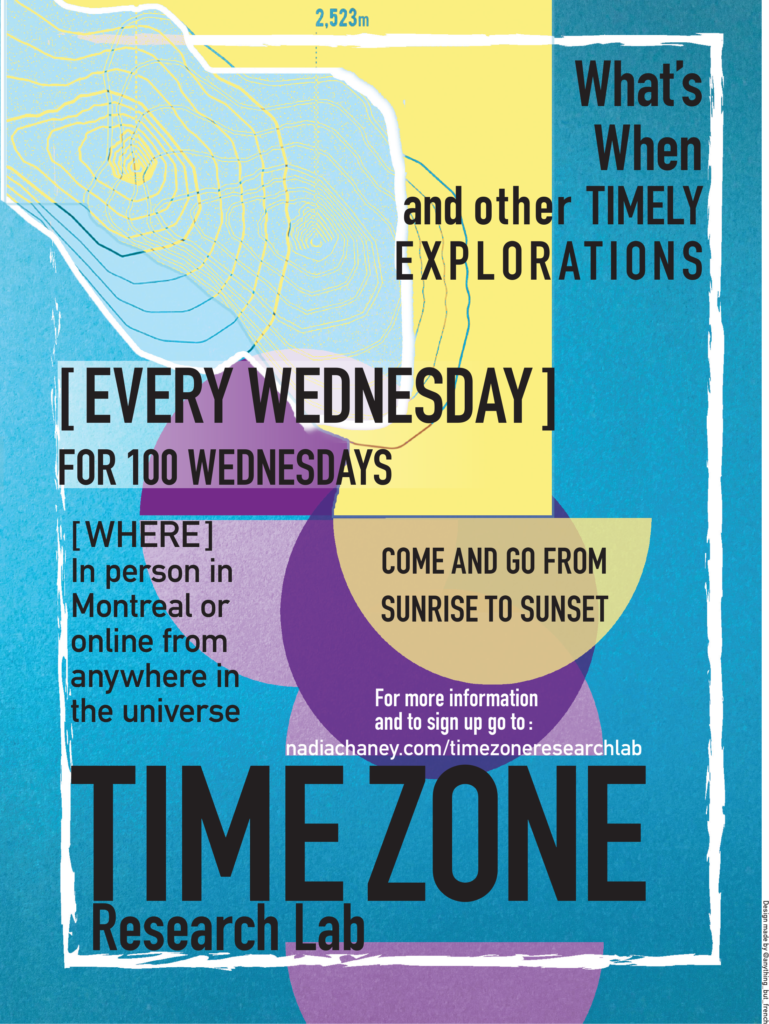
The Time Zone Research Lab is a community-arts-based investigation into the nature of time and temporality.
We have two main research questions:
1.
How can we be more intimate with Time?
2.
Is Time imprisoned and if so how can we help to liberate it?
The Time Zone Research Lab is a community-arts-based investigation into the nature of time and temporality.
We have two main research questions:
1.
How can we be more intimate with Time?
2.
Is Time imprisoned and if so how can we help to liberate it?
What did we learn and how did we learn it
The Time Zone Research Lab was a 100-week online drop-in hub with a transdisciplinary approach where we studied a range of texts from physics to philosophy to poetry to religion to anthropology to archeology to science fiction and more. Rather than thinking of this approach as eclectic I imagined that the ubiquity of time requires an interdisciplinary approach. This approach is NOT intended as a teachable methodology, it was designed uniquely for this Lab.
The reading was done in a signature style which I call “interrupted reading”, where the interleaving of voices and the feeling forward into meaning making was more important than individual voices of either writer or any single participant. Along with interrupted reading we employed over a dozen other reading, dialogic, community building and archival practices. Below are a few examples.
Mending the Web: 2 hour open drop in time before the reading session would begin. A time to connect, to support each other, and to mull over previous sessions.
Recapping: Whenever anyone would drop in we would greet them with “you’re right on time, and then recap the reading and conversation for them. The recapping expectedly became an essential pedagogical mechanism, helping us to consolidate memories and check for understanding.
The Voice of Time: (designed by Venu Dodavarappu) was a collaborative poem written by listening to the “voice” of time and recording it in the chat. Every reading session would open with the voice of time from the week before.
Puppet Parties: (designed by Ley McDonell) were held at the end of each 12 week session. Puppets were made of the authors, ideas, and themes that we had encountered, and then we would improvise puppet plays. There was a high level of nonsense and whimsy, and it was quite astonishing how well they worked as capstones before moving into another season.
The Time Zone continues as a lyrical educational architecture that attempts to learn without grasping. We practice de-possessing knowledge, we do not try to win it or overcome it or master it, but to be multiple and resonant with the learning by relating with it.
The Time Zone will awaken in 2026, after a five year resting phase. The phase 1 archive is fresh and bubbling, openly accessible to all. Please read the FAQs below, and use the sign up form to join us.